Home → / Wine Regions → / North America / United States / Arizona Wine Country
Arizona · Places, people & the work of growing wine
Arizona Wine Country
High-country vineyards, pioneering people and the waterways of the Verde Valley: choose a place, follow a grape, and discover the Arizona behind the bottle.

Find your bearings.

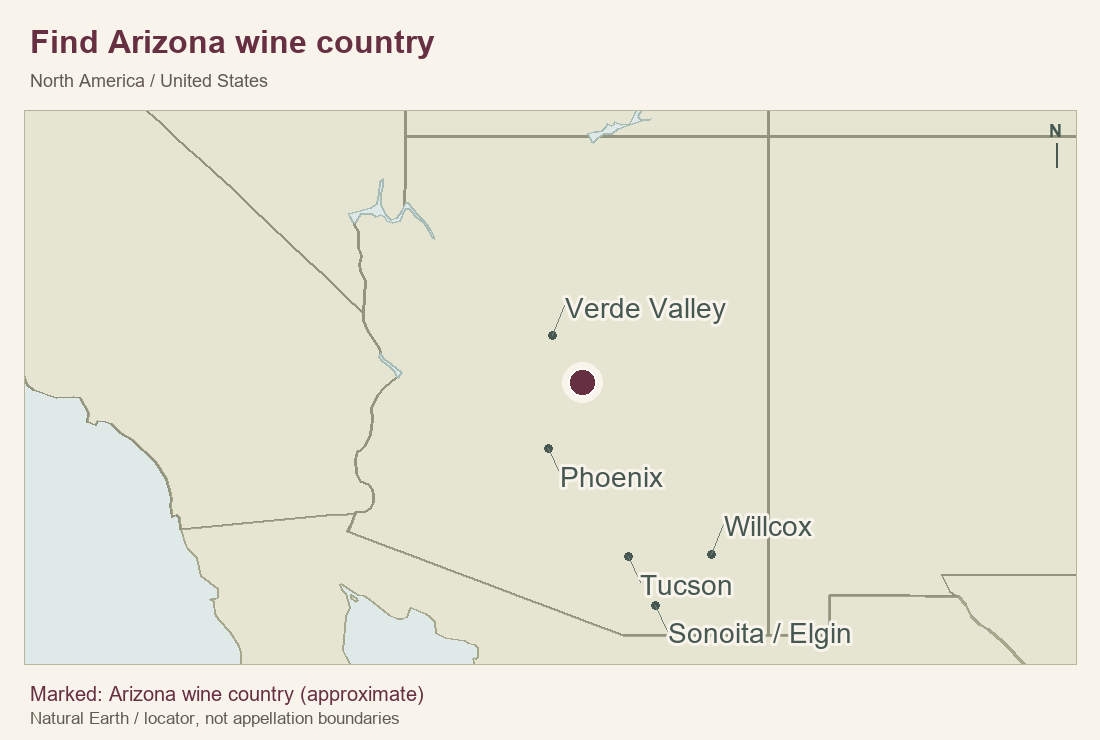

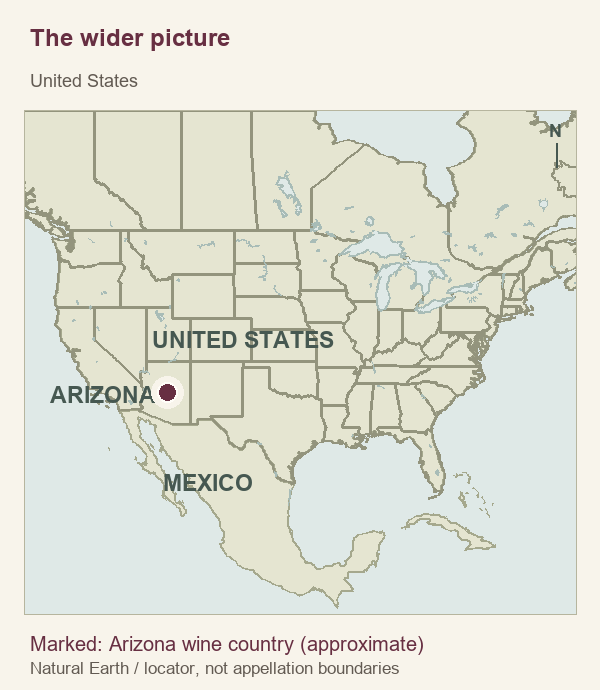
A different picture of Arizona.
Start with the high country: open grasslands, mountain-framed basins and a northern valley threaded by water. Wine gives us another way to explore Arizona, one vineyard and one person at a time. The heat of a Phoenix pavement tells us little about a vine growing far above it.
The University of Arizona studies climate, soils and topography across Sonoita, Willcox and Verde Valley. That is a useful invitation: look at the particular growing place, then ask what the maker does with its fruit. Elevation, exposure and the season all belong in the conversation.
Follow the creek and river
Verde Valley, Oak Creek & the Verde River → Begin with Cottonwood, Clarkdale and Page Springs, then trace the vineyards behind the tasting rooms.
Follow the growers
Willcox → Explore southeastern Arizona’s vineyard country, Sam Pillsbury and the fruit that travels to cellars elsewhere.
Follow the pioneers
Sonoita & Elgin → Meet the southern grassland landscape, Gordon Dutt’s research legacy, Callaghan and Dos Cabezas.
Oak Creek and the Verde River: a living thread.
In northern Arizona, Oak Creek descends through canyon country and the Sedona area before joining the Verde River. The Verde continues towards its meeting with the Salt River. These waterways connect places that can look separate on a tasting-room list.
Follow the water
- Oak Creek
- Verde River
- Salt River
A connection diagram, not a scale map or a driving route. Oak Creek is one of several tributaries feeding the Verde.
The wider watershed supports communities, farms and wildlife as well as recreation. Friends of the Verde River describes groundwater springs and tributaries as part of that system. A vineyard view is an invitation to learn how the place works, including where irrigation water comes from and how habitat is protected.
Follow the fuller Verde Valley story → for Oak Creek vineyards and the distinction between the river, the wider landscape and the defined wine appellation.
The people make the landscape a story.
Arizona’s modern wine revival includes soil scientist Gordon Dutt, whose research and southern Arizona vineyard work helped open a path for later growers. The Arizona Wine Growers Association places that work at the centre of its modern history.
Sam Pillsbury · a filmmaker turns grower
Pillsbury offers a story of curiosity, a taste of Arizona Chardonnay and an interest in Rhône grapes. His company’s July 2026 update says the vineyard and winery are off the market and that he is making wine again. Read the current producer account.
Arizona Stronghold · follow the fruit
Its producer account connects Bonita Springs Vineyard in the Willcox AVA with an Old Town Cottonwood tasting room and additional Arizona grape sources. One brand can lead us to several growing places. Meet Arizona Stronghold.
Eric Glomski · the Oak Creek connection
Page Springs Cellars links vineyard work with a creekside setting. Its own account describes native vegetation between vineyard blocks and wildlife access to the water. Explore its vineyard and farming account.
The next generation · Clarkdale
Yavapai College’s Southwest Wine Center brings students, faculty and alumni into an estate vineyard and teaching winery. Learning is part of this region’s story too. Discover the Southwest Wine Center.
Familiar grapes, unexpected company.
Cabernet Sauvignon, Merlot and Chardonnay offer familiar doors into Arizona wine. Producers also work with Mediterranean and other European varieties. Dos Cabezas’ vineyard lists, for example, include Picpoul Blanc, Malvasia, Roussanne, Graciano and Aglianico across its southern sites.
Let the actual bottle lead. A grape may appear on its own, in a named blend or in different proportions from one vintage to the next. Arizona is a place of origin; it does not prescribe a single style.
Where you taste and where the grapes grew.
A Cottonwood tasting room can pour a wine made with Willcox fruit. A producer based in Sonoita can farm another vineyard in Cochise County. An Arizona name on the label and a welcoming address on a map answer different questions.
TTB’s establishment list records Sonoita in 1984, Willcox in 2016 and Verde Valley in 2021. These are defined grape-growing origins. Towns, drainage basins and visitor trails have their own geography; they do not replace the wine appellation.
Let your curiosity choose the route.
Make an Arizona bottle passport.
Choose a wine and write down its vintage, grapes, named vineyard or appellation, cellar location and tasting-room location. Can you connect those places on the map? Add a question about water or farming, and another about the blend.
For physical travel, carry those questions into The Wandering Cork. Check current producer arrangements before setting out; the discovery begins well before the first pour.
Meet the people behind these places.
Choose the story that catches your curiosity. Vineyard sources, cellar addresses and visitor locations are distinguished within each profile.
- Sam Pillsbury · film, vineyards & Rhône-inspired wines
- Arizona Stronghold · Willcox fruit & Cottonwood
- Eric Glomski · Page Springs & Oak Creek
- Kent Callaghan · listening to an Elgin vineyard
- The Bostock family · Dos Cabezas & two vineyards
- Merkin & Caduceus · the Keenan team, Cottonwood & Jerome
- Gordon Dutt & the next generation · from trials to Clarkdale
Follow an ingredient too: Viognier · Vermentino · Aglianico.
Behind this introduction.
Editorial sources checked 25 October 2026. Producer accounts are identified as such. Maps use public-domain Natural Earth data and approximate location markers; legal appellation boundaries are not shown.
- University of Arizona: climate, soil and topography
- Friends of the Verde River: watershed connections
- Arizona Wine Growers Association: history
- TTB: AVA establishment dates
- Pillsbury: current producer update
- Arizona Stronghold: vineyard and tasting-room account
- Page Springs Cellars: vineyard and farming account
- Dos Cabezas: vineyard varieties
- Southwest Wine Center: teaching winery
- Natural Earth: map data