Discovery / Wineries / Lingua Franca
Wineries · Follow your curiosity
Lingua Franca
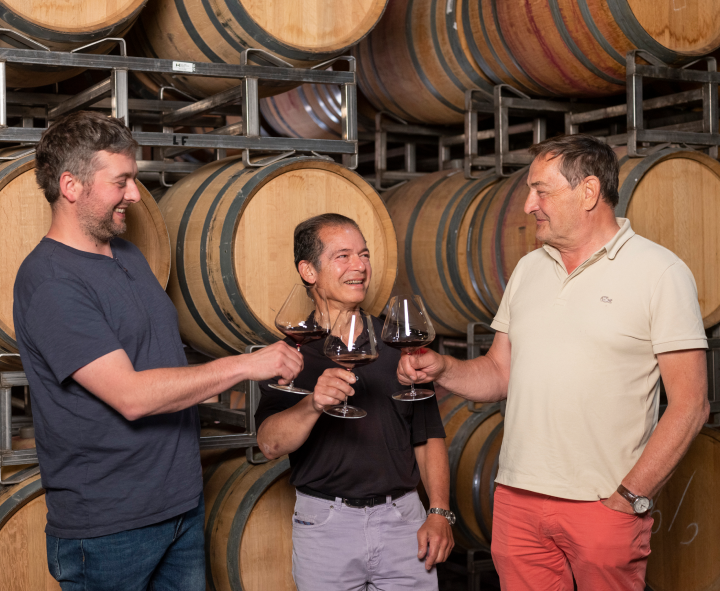
An Oregon hillside brought Larry Stone, Dominique Lafon and Thomas Savre into a shared pursuit: Pinot Noir and Chardonnay that express the Eola-Amity Hills.

A little acquaintance, at a glance.
- Origin
- Eola-Amity Hills · Oregon
- Wider region
- Willamette Valley
- Grapes to follow
- Pinot Noir · Chardonnay
- Founders
- Stone · Honig · Lafon
A vineyard that brought people together
Lingua Franca began with Larry Stone’s belief in a vineyard site in the Eola-Amity Hills. He acquired the Janzen Farm at the end of 2012 and planted Pinot Noir and Chardonnay. The estate’s account places Dominique Lafon’s recognition of that site at the turning point: the Burgundian winemaker proposed making wine together.
Founded in 2015 by Stone, David Honig and Lafon, the project brought Thomas Savre into the winemaking role. Their different experiences met in a shared ambition to understand this Oregon hillside. Lingua Franca’s name—the idea of a common language across backgrounds—gives that collaboration a fitting expression.
Burgundy experience, an Oregon voice
Lafon’s reputation was rooted in Meursault and the work of his family’s domaine. Savre brought Burgundy training and cellar experience, then a working relationship with Lafon at Evening Land in Oregon. Their shared history gave the new venture a foundation of trust and practical experience.
The estate describes Savre arriving as its first employee in May 2015. His task placed the vineyard’s individual blocks at the centre of the work: observing differences, learning from each harvest and carrying those distinctions into the wines. Lafon’s own reflections describe adapting Burgundy knowledge to Oregon’s conditions. The ambition was for the place to find its own expression.
That is the thread to follow through Lingua Franca’s Pinot Noir and Chardonnay: Larry’s conviction about the land, Lafon’s recognition of its potential, and Savre’s detailed winemaking work. The wider team and the way the vineyard is farmed belong in that story too.
Alongside estate fruit, the winery has used other Willamette Valley vineyard sources. A particular wine’s vineyard and vintage notes provide the next chapter. Follow our Burgundy regional guide → to understand the French connection, then return to the Willamette Valley → for its Oregon setting.
Explore an actual winery
The photographic tour here is the Google-hosted view linked from Lingua Franca’s official visiting page. Explore the space, then ask which activity each area supports. A tour image documents a place at the time it was photographed; it does not establish today’s complete equipment inventory.
Receiving and fermentation
Where does fruit arrive, and how are different lots kept separate?
Maturation
Which vessels are in view? Their presence does not tell you which wine used them or for how long.
Tasting and assembly
How does a team evaluate parcels and choose the final wine? Several lots can share one grape.
Two grapes, two useful trails
Our Pinot Noir Wines guide explores red-wine handling and the assembly of lots. Chardonnay Wines opens pressing, lees, vessel choices and malolactic decisions. Read these beside the estate’s own account to separate a general method from a documented practice for a specific bottling.
Then return to Willamette Valley for the broader map. A regional introduction, a winery profile and a wine guide answer related but different questions.
Planning a closer look
Use the official visiting page for current experiences and booking information. The photographic tour offers an introduction to the place; follow the winery’s visiting information to plan an experience.
For the founding voice, follow the credited 2019 Larry Stone oral history. Its date matters: it preserves the project’s earlier story without serving as a current ownership chart.
A small Cork Dork discovery
Give your curiosity a little room.
Explore the photographic tour, then choose one estate wine description. Record grape, vineyard source and disclosed cellar choices. Mark which observations came from the tour and which came from the wine’s own documentation.
Your observations, your words. Small pours welcome.
A few questions worth uncorking.
Is Lingua Franca in Burgundy?
No. It is in Oregon’s Eola-Amity Hills within the Willamette Valley.
Does every bottle necessarily use only one estate parcel?
No. Read the source details for the particular wine.
Does seeing a barrel in a tour prove a wine aged in it?
No. A room view and a wine’s production record are different evidence.
Where shall we wander next?
Meet Larry Stone →Willamette Valley →Pinot Noir Wines →Chardonnay Wines →Barrels & Sizes →Blending Wine →Behind this introduction
Editorial sources checked 24 October 2026. Historical dates describe the source’s period; current wines, visits and personnel can change. Follow the linked primary sources for details.
- Lingua Franca: founding story, site and grapes
- Eola-Amity Hills association: winery, estate and other sources
- Lingua Franca: current visiting information and photographic tour
- Linfield University: Larry Stone oral history
- Lingua Franca: Larry’s commitment to the site and Lafon’s proposal
- Lingua Franca: Dominique Lafon on Burgundy and Oregon
- Lingua Franca: Thomas Savre’s training and arrival
- Lingua Franca: founders, Savre and the vineyard philosophy
Follow the Burgundian connection.
Dominique Lafon → From Meursault to Oregon, explore the grower’s perspective behind the collaboration, and distinguish the person, family estate and independent business.
The winemaker’s adjoining chapter.
Read Thomas Savre’s story → for Burgundy training, Lingua Franca’s founding cellar team and the assembly of vineyard lots. Continue with Côte de Nuits, Nuits-Saint-Georges and Meursault to place the Burgundy connections on the map.