Discovery / Wine Regions / Sierra Foothills
Wine Regions · Follow your curiosity
Sierra Foothills
Gold Rush country, hillside vineyards and an unusually broad grape conversation: find California’s Sierra Foothills, then follow the smaller names within it.

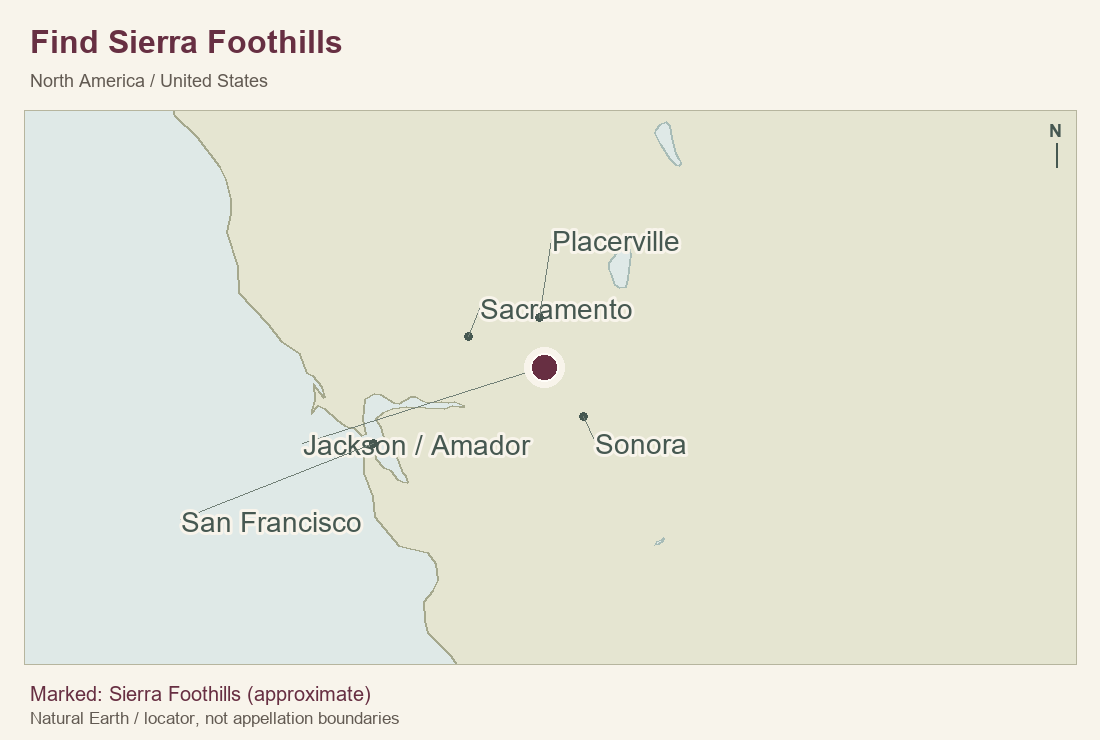

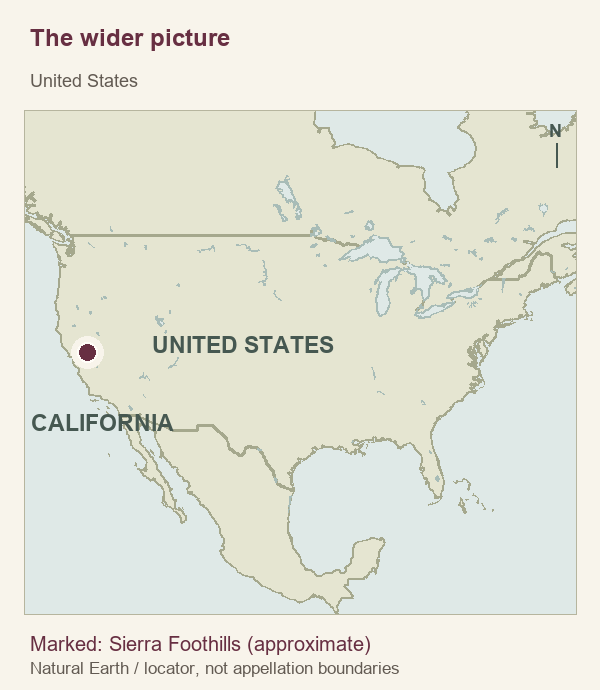
A little acquaintance, at a glance.
- Country
- United States · California
- Setting
- Western Sierra Nevada foothills
- Label family
- Sierra Foothills AVA
- Look closer
- Amador · El Dorado · Calaveras
First, find your bearings
The Sierra Foothills lie east of California’s Central Valley, along the western side of the Sierra Nevada. Sacramento is a useful city reference, with the wine country stretching north and south through foothill communities. The maps provide orientation; the dot is not an appellation boundary.
The broad Sierra Foothills American Viticultural Area reaches into portions of eight counties: Yuba, Nevada, Placer, El Dorado, Amador, Calaveras, Tuolumne and Mariposa. It is a defined wine-growing origin, not a synonym for every vineyard anywhere in the Sierra Nevada.
A region has places within it
Amador County
A county name within the wider foothill story. Plymouth, Sutter Creek and Jackson help you find your bearings.
California Shenandoah Valley
A smaller AVA spanning parts of Amador and El Dorado counties, within the Sierra Foothills. Do not confuse it with Virginia’s Shenandoah Valley.
Fiddletown and beyond
Fiddletown is another smaller AVA. El Dorado and Calaveras open further local conversations; the broad region contains varied sites.
Gold, vines and a continuing story
Viticulture accompanied the nineteenth-century Gold Rush. Zinfandel remains an important connection, with historic vineyards contributing to the region’s identity. But a foothill wine is not automatically an old-vine Zinfandel, and an old planting is not a complete account of the wine’s quality.
Warm days, cooler nights, elevation, exposure and soils create different growing conditions across the foothills. A county or regional name cannot replace the details of a vineyard. Ask how high the site sits and which way it faces before assuming all the region’s grapes ripen alike.
Start with these grapes
Zinfandel
Follow the grape into Zinfandel wines, then investigate the vineyard named on a bottle.
Barbera and friends
Our Barbera, Sangiovese and Petite Sirah introductions open useful comparisons.
More than reds
A region’s best-known red wines do not exclude white grapes. Look for the specific variety and origin rather than treating the foothills as one colour of wine.
A maker to meet: Jeff Runquist
Jeff Runquist Wines is based in Amador County and provides a particularly wide-ranging tasting conversation. Its fruit sources extend into other California regions too. A winery’s street address tells you where the business is based; the origin on each bottle tells you a different part of its story.
Read Jeff’s people profile alongside the winery entry. Growers, grapes and a winemaker’s decisions connect the map to what finally reaches the glass.
A small Cork Dork discovery
Give your curiosity a little room.
Find two bottles with foothill origins, preferably naming different smaller places. Record grape, county or AVA, vineyard and producer. Use the maps to locate them, then compare small pours without expecting one universal foothill flavour.
Your observations, your words. Small pours welcome.
A few questions worth uncorking.
Is Amador County the whole Sierra Foothills?
No. It is one part of the wider region.
Is California Shenandoah Valley the Virginia region?
No. They are different American wine origins.
Does an Amador winery use only Amador grapes?
Not necessarily. Check the origin on each wine and its producer information.
Where shall we wander next?
Meet Jeff Runquist →Jeff Runquist Wines →Zinfandel →Barbera →Petite Sirah / Durif →Sonoma County →Behind this introduction
Editorial sources checked 24 October 2026. Historical dates describe the source’s period; current wines, visits and personnel can change. Follow the linked primary sources for details.