History of wine · Chapter one
Wine’s Earliest Traces
Wine’s early history survives in traces left inside clay vessels, offering clues to ancient lives while leaving the first winemaker’s story untold.

The quick profile
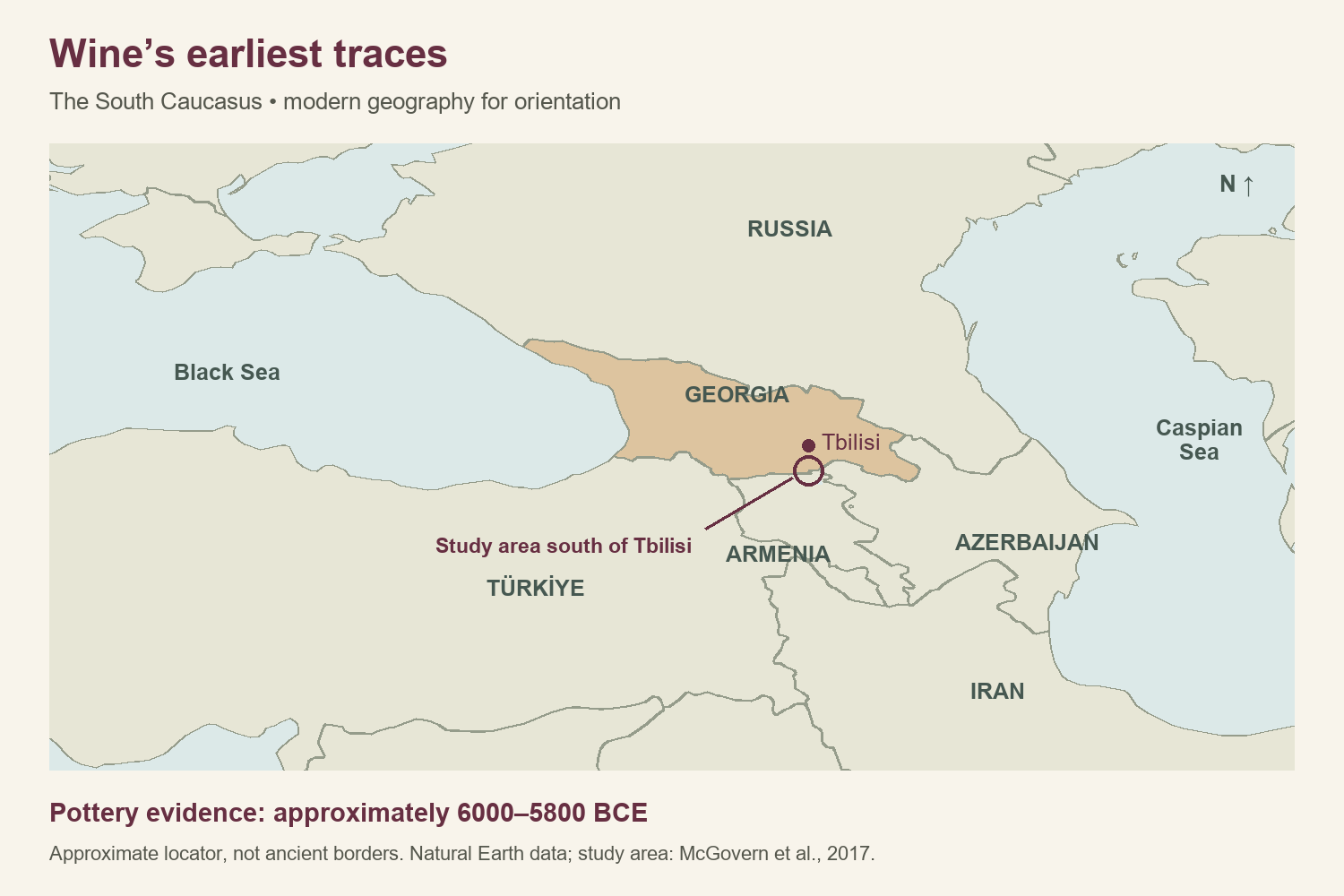
- Where: South Caucasus, including sites in modern Georgia.
- When: Pottery evidence dated approximately 6000–5800 BCE.
- The clue: Chemical residues interpreted alongside archaeology and plant evidence.
- Why it matters: Surviving evidence gives us a starting point for discovery, rather than an exact moment of invention.
A vessel to look at closely

Notice the opening, the joins between fragments and the narrow base. Those are visible observations. The contents and use of an ancient vessel require further evidence.
Begin with what remains
A wine bottle can carry a vintage, a grape and a producer’s name. An ancient pottery fragment offers a different kind of introduction. Its interest lies partly in material too small to see: compounds absorbed into the clay when a vessel held something long ago.
Researchers studying pottery from two Georgian sites reported evidence for grape wine dating to about 6000–5800 BCE. Their interpretation combined chemical findings with archaeological, botanical and environmental evidence. It is a remarkable glimpse of early wine in the South Caucasus. It does not identify a first winemaker or prove that no earlier wine existed elsewhere. Research: McGovern and colleagues, PNAS, 2017.
How a fragment becomes evidence
Archaeology asks several questions together. Where was the material found? How was its context dated? Which residues were detected? Do other finds support the interpretation? The result is stronger when different kinds of evidence tell a compatible story.
In the Georgian study, residues in ceramic vessels were interpreted as evidence of grape wine. The surviving finds invite us to imagine repeated practical choices about grapes and containers. They cannot recover every detail of how a particular drink tasted. University of Pennsylvania account of the discovery.
Clay is also part of a living story
Georgia’s qvevri tradition gives us another reason to look closely at vessels. UNESCO describes an egg-shaped earthenware container used for making and storing wine, with knowledge shared through families and communities. This is living cultural heritage, not merely a museum subject. Its recognition on UNESCO’s list in 2013 concerns the traditional method; it should not be confused with the date of an excavated object. UNESCO: traditional qvevri winemaking.
A vessel gives the History collection a useful bridge into Methodology. Today we can ask what clay, oak or stainless steel contributes to making a wine, while keeping ancient evidence and present-day practice distinct.
Three things to notice
A date belongs to evidence. A dated find tells us when a surviving object or context belongs, not the birthday of wine everywhere.
A container has a job. Ask how a vessel could be filled, cleaned, closed and stored. Practical questions make distant history more approachable.
Tradition has people behind it. Wine’s history includes the people who make vessels, tend vines, share knowledge and pass on customs.
Try a little discovery
Look at a photograph of an archaeological vessel and a documented modern qvevri. First read their dates and descriptions. Then note what you can actually see: material, shape, opening and scale. Separate those observations from guesses about the wine they once held. No tasting or purchase is needed for this discovery.
A few questions worth uncorking
Was wine invented in Georgia? The Georgian finds provide important early evidence of grape wine. Establishing a single invention place is a larger claim than identifying the oldest surviving evidence in a particular study.
Are ancient wine and modern Georgian wine the same? Shared geography or a clay container does not establish identical grapes, methods or flavors across thousands of years.
Why start History with pottery? It makes the link between evidence and interpretation visible, and connects naturally with our guides to fermentation, skin contact and winemaking vessels.
Where shall we wander next?
A short timeline
Approximately 6000–5800 BCE: the period associated with the Georgian pottery evidence discussed here.
2013: UNESCO inscribes the traditional Georgian qvevri winemaking method on its Representative List.
2017: McGovern and colleagues publish the archaeological study in PNAS.
Behind this introduction
Editorial sources checked 15 October 2026. Research links appear beside the relevant passages. Map data: Natural Earth (public domain). Museum photograph credited beside the image. Historical evidence remains open to new findings and interpretation.
History of wine